Pub

Your Ad Here
Showing posts with label Culture. Show all posts

Sunday, 8 January 2012

Alnwick Castle (England)

One of the best-known castles in Britain, its current popularity partly attributable to its starring role in the Harry Potter films, Alnwick's history is as interesting as any work of fiction. The castle is still the seat of the Dukes of Northumberland and is the second-largest inhabited castle in the country.

History
Yves de Vescy built the earliest parts of the fortress in 1096 and by the middle of the 12th century the castle had taken on the basic plan that remains today. It was one of the earliest Norman fortresses to have been built without a square keep, and fragments of the Norman masonry still exist in curtain walls.
The de Vescys held Alnwick through several sieges and periods of turbulence (Eustace de Vescy was a ringleader of the Baron's Revolt in 1212;the castle was ordered to be destroyed,but this wasn't carried out) until early in the 14th century when the fortress and manors of Alnwick were handed to Anthony Beck, Bishop of Durham. The direct male line of the de Vescys died out in 1314 at the Battle of Bannockburn and the de Percy family, who became one England's most powerful dynasties, came to Alnwick in 1309.

Today
Today the castle receives around 300,000 visitors and is becoming recognized as a mustsee destination nationally and internationally.
There certainly is plenty here to occupy visitors of all ages. The Harry Potter link will engage many children and,one day a week in the summer, Hagrid and Professor Dumbledore are on hand to perform magic. The Knight's School allow youngsters to experience what it was like to train as a Knight. Also in summer a magician performs tricks and birds of prey are demonstrated. Alnwick's website offers lots of game and fun for kids. If you feel like a break for refreshments,there is a tea room.
The castle is filled with treasures, including paintings by artists such as Bellini,Gainsborough and Claude Lorraine, furniture and statues accumulated by the family and it has its own museum.Events are staged regularly and there are permanent displays to further your knowledge about the castle and the part it played in history.

How to get there:
Location: Northumberland
Map ref: NU 187137
Tel: 01665510777 or
      01665511100 (24hrs)
Web: www.alnwickcastle.com
Open: April-late October daily 11-5


Monday, 2 January 2012

Warwick Castle (England)

Warwick Castle


As medieval castles go, Warwick has to be one of England's most evocative,redolent of the history that shaped it since William the Conqueror first built his motte and bailey fortress here in 1068.

The Earl of Warwick

William's mound is all that survives of that fortification but over the centuries the castle grew into an impressive stronghold to reflect the status of its owners. By 1088 this was the seat of the Earls of Warwick who were to become significant figures in Britain's story.
By the middle of the 13th century the castle had an imposing gatehouse inserted into its stone curtain and a shell keep crowning the motte. The main protagonist in the Barons' War,Simon de Montfort,lived at neghbouring Kenilworth Castle, so attack was almost inevitable when Warwick sided with Henry III.
Four years later the de Beauchamps inherited the earldon: it was Guy de Beauchamp who helped to seize and trick Edward II's favourite,Piers Gaveston,leading to Gavesron's trial and execution at Warwick in 1312. Early in the 15th century the family's influence at Court was great enough for Henry v to appoint Richard de Beauchamp as tutor to his son Prince Henry ( Henry VI )

A top visitor attraction

In 1978 Warwick was sold by the Grevilles to the tussauds group, which has put much effort into restoring and developing the castle, now one of Britain's top visitor attractions.
Displays in the castle include period furnishings and the extraordinarily lifelike waxwork models, and show the life of the castle through the ages up to the late Victorian era.
Parts of the medieval castle are incorporated into the state rooms, which were refurbished mainly in the 17th and 18th centuries. Today the castle is one of the best places in England to get a flavour of life in a medieval castle. There is a full calendar of events and the website is excellent. Restaurants serve refreshments.

How to get there:

Address:
Warwick CastleWarwick
Warwickshire
CV34 4QU

Map ref :
SP 284647

Tel:
0870 442 2000

web:

Open:
Daily 10-5 Jan-Mar,Oct-Dec;
10-6 Apr-Sep


Friday, 30 December 2011

Goodrich Castle (England)

Goodrich Castle
Standing in open coutryside above the River Wye,Goodrich Castle is one of the finest and best preserved of all English medieval castles.Despite its setting near the Anglo-Welsh border,the castle led a largely peaceful existence,and its ruined state is the result of a single violent episode during the Civil War of the17th century.
A castle has stood in this area since the 11th century and the site still contains a small keep built in the 12th century,probably by Richard "Strongbow" de Clare (d.1176),who achieved fame as conqueror of Ireland in the 1170s.The castle's defences were upgraded when it passed to William Marshal (d.1219),one of the greatest soldiers of his time.But Goodrich was largely rebuilt in the late 13th century after Henry iii gave it to his half-brother,William de Valence (d.1296),an ifluential figure at the royal court who accompained Edward i on crusade in 1270. At Goodrich he created one of the most up-to-date castles of its period - an impressive defensive shell, concealing residential buildings of extraordinary complexity and architectural sophistication.
The castle survived,slightly altered in the later Middle Ages, until 1646,when its Royalist garrison was forced to surrender to Parliamentarians after two-month siege,and much of the castle was ruined by mortal fire. In the 18th and 19th centuries the overgrown ruins became a magnet for visitors in search of the Picturesque or attracted by the caste's historic associations.


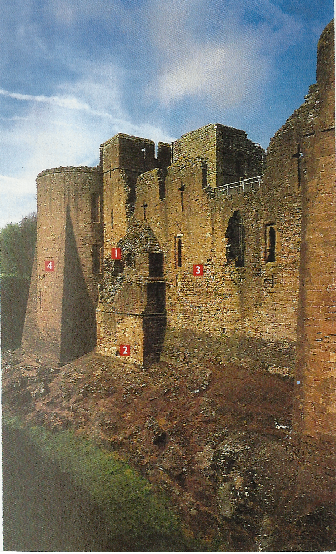
Garderobe Tower
At the south end of the east range is the garderobe tower; added to the east curtain wall in the later Middle Ages to replace a small single latrine. This tower is one of the most remarkable features of Goodrich Castle and the survival of such a large example is extremely rare in England and Wales. It was a communal latrine for the convenience of the whole household, several of the whom could use it at a time. At the level of the courtyard, three doors opened inwards into the latrine chambers, which projected beyond the line of the curtain wall in a hollow masonry buttress; each chamber may have contained more than one seat. The back wall of the tower contained to further chutes, probably ventilation shafts running upwards from the cesspit at the bottom of the buttress. Waste could be cleared out of the cess through an arched opening into the eastern ditch of the castle.


The East Wall


1-Remains of three latrine chambers in the garderobe tower.

2-Outlet through which waste could be shovelled into the ditch from the garderobe tower.

3-Change in mansory, showing probable early 13th-century walling below and late 13th- - century walling above.

4-South-East Tower


How to get there:
Location Nr Ross-on-Wye,Herefordshire
Map Ref SO 577200
Tel 01600890538
Open Daily 10-5 March-May, September-October; 10-6 June- August; Thursday- Monday 10-4 November-February.

Refreshments: Car park.Ye Hostelrie Hotel, Goodrich
toilets: Car park